Comparison
Best Microwaves Compared
A microwave is one of those appliances you use five times a day without thinking about it—until the wrong one slows you down, beeps through nap time, or cannot fit a dinner plate. This guide compares every microwave we review on BestPrimeDayDeals.com: three compact-to-mid-size countertop models for everyday kitchens, one over-the-range unit that doubles as a range hood, and two commercial-grade workhorses built for heavy reheating. The right pick depends less on brand loyalty and more on how much counter space you have, whether you need venting, and how often you push a microwave past light-duty reheating.
Updated 2026-06-07 · 18 min read
Affiliate note: BestPrimeDayDeals.com is a participant in the Amazon Services LLC Associates Program. We may earn a commission when you buy through links on this page, at no extra cost to you. Read our full disclosure.
Bottom line
Choose COMFEE' for the tiniest spaces, BLACK+DECKER for compact everyday reheating, TOSHIBA for sensor-smart family cooking, GE for over-the-range venting, and Panasonic or Sharp when you need commercial durability without a turntable.
No single microwave wins every kitchen. The big split is footprint versus capacity, countertop plug-and-play versus built-in over-the-range installation, and residential convenience features versus commercial-grade stainless construction.
At-a-glance picks
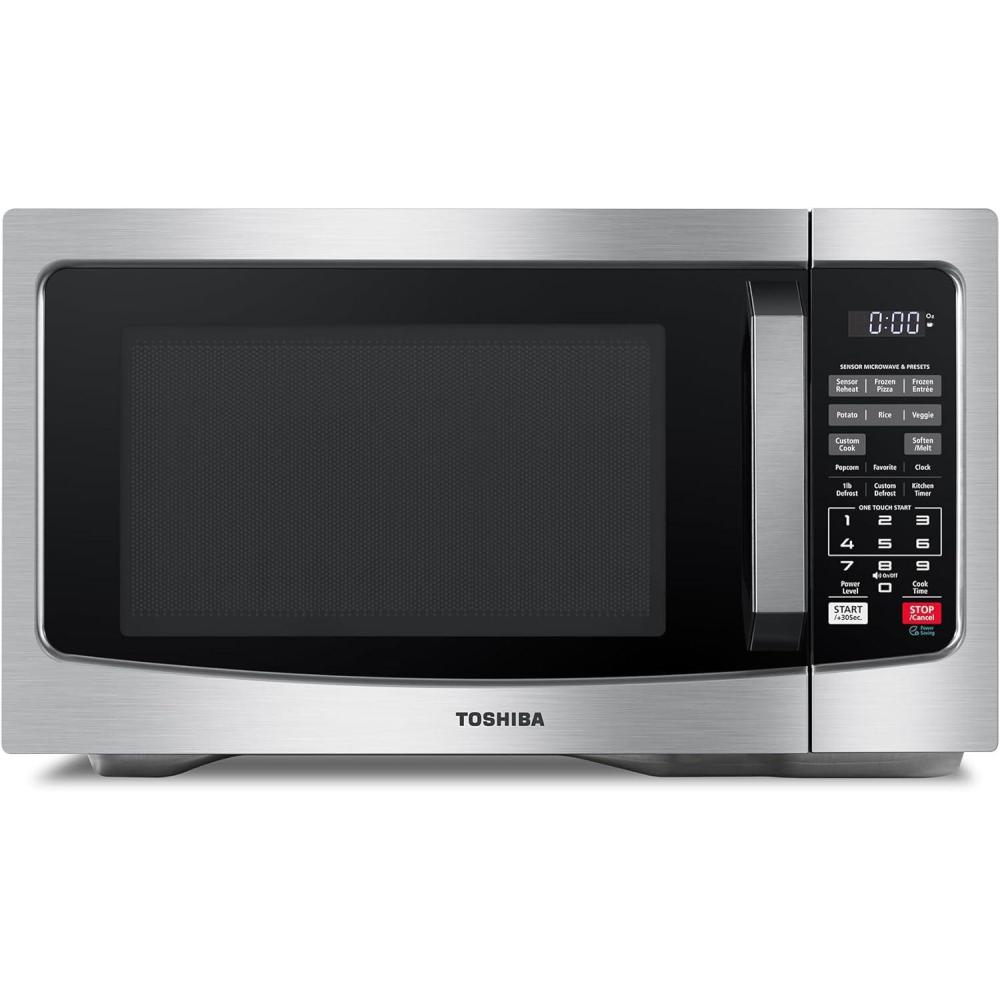
TOSHIBA EM131A5C-SS
1.2 cu ft, 1000W, smart humidity sensor, mute mode, and child-safe handle for everyday family reheating.
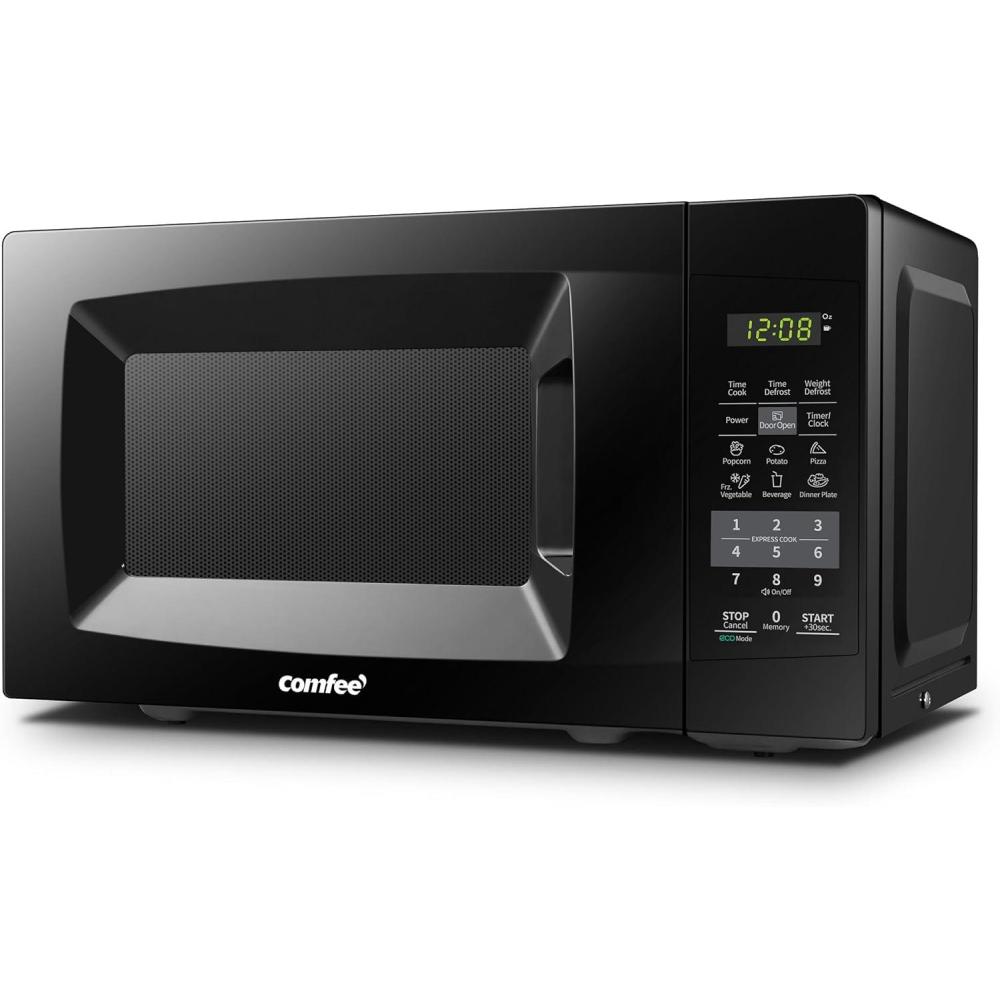
COMFEE' EM720CPL-PMB
0.7 cu ft, 700W, mute function, ECO mode—the smallest footprint for light-duty reheating in tight spaces.
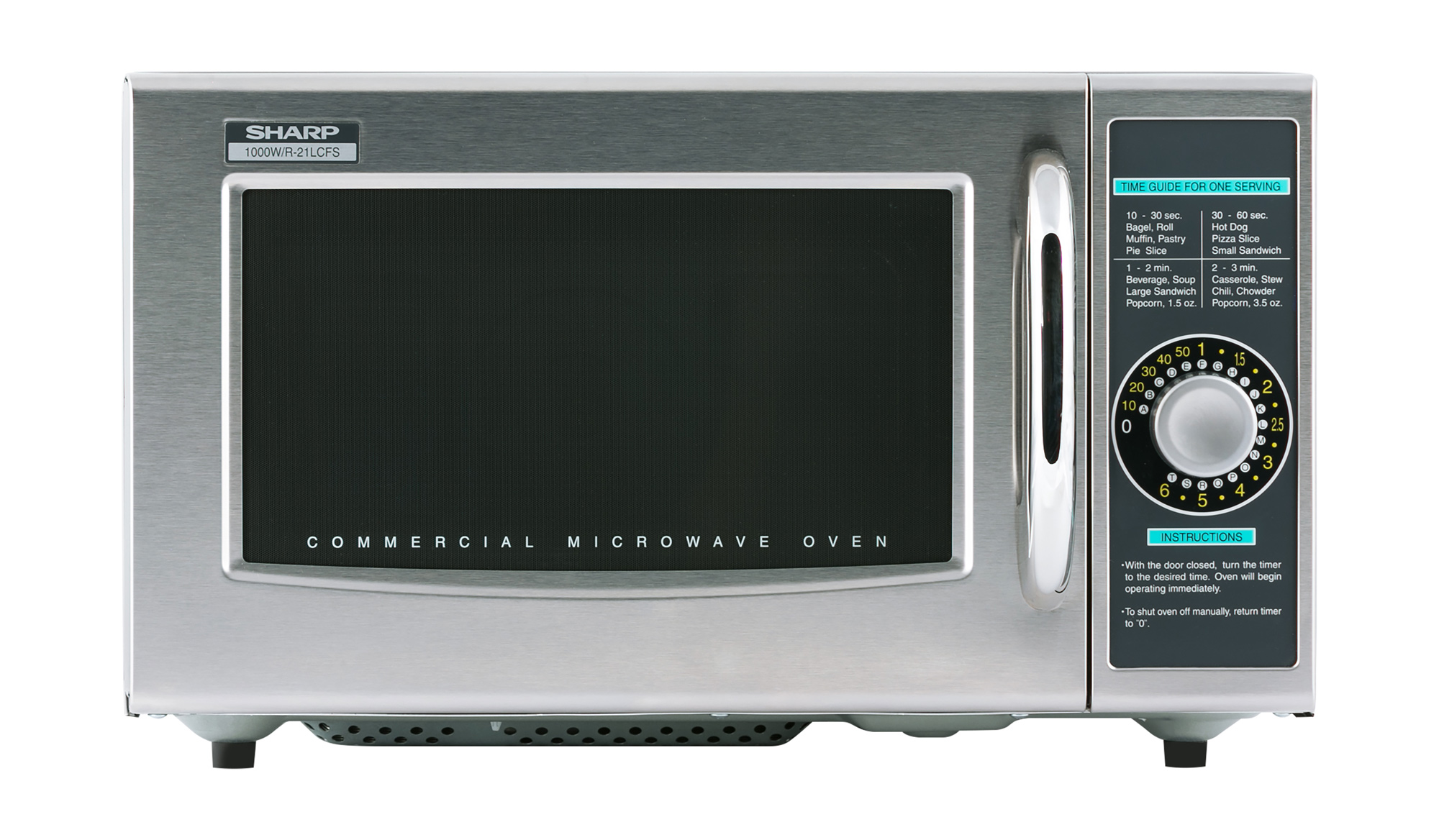
Sharp R-21LCFS
Dial-only 1000W commercial microwave with a flat stainless floor—built for all-day reheating and fast cleanup.
Full comparison chart
This chart focuses on buyer-relevant differences rather than stale prices. Use the Amazon links for live pricing.
| Model | Type | Capacity | Power | Turntable | Key Features | Best For | Review | Amazon |
|---|---|---|---|---|---|---|---|---|
| TOSHIBA EM131A5C-SS | Countertop | 1.2 cu ft | 1000W | Yes (12.4") | Smart humidity sensor; 12 auto menus; mute; ECO mode; child-safe handle; easy-clean interior | Families & apartment dwellers wanting sensor cooking in a mid-size footprint | Read review | View |
| BLACK+DECKER 0.9 Cu Ft | Compact countertop | 0.9 cu ft | 900W | Yes | 6 auto menus; 10 power levels; one-touch start; child lock; memory function; fits 10" pizza | Students, small households, office break rooms, and kitchens with limited counter space | Read review | View |
| COMFEE' EM720CPL-PMB | Compact countertop | 0.7 cu ft | 700W | Yes | Sound on/off; ECO mode; 11 power levels; one-touch buttons; auto-cook menus; very small footprint | Dorms, RVs, office break rooms, and very small kitchens needing light-duty reheating | Read review | View |
| GE JVM3160RFSS | Over-the-range | 1.6 cu ft | 1000W | Yes (on/off) | 30" install; 300 CFM two-speed hood vent; LED cooktop lighting; auto/time defrost; stainless finish | Homeowners replacing a 30" over-the-range unit who want built-in venting and counter space back | Read review | View |
| Panasonic NE-1054F | Light-duty commercial countertop | 0.8 cu ft | 1000W | No | Bottom energy feed; 10 programmable memory pads; 6 power levels; 2–3 stage cooking; Grab & Go handle; Braille keypad; NSF/UL commercial | Cafés, small restaurants, break rooms, and serious home cooks wanting compact commercial-grade heating | Read review | View |
| Sharp R-21LCFS | Medium-duty commercial countertop | 1.0 cu ft | 1000W | No | Dial timer (10 sec–6 min); flat stainless floor; auto-cancel timer on door open; durable commercial build | Restaurants, food trucks, and home kitchens that want a rugged, no-frills commercial dial microwave | Read review | View |
Small countertop microwaves: COMFEE' vs BLACK+DECKER vs TOSHIBA
These three models form the heart of most shopping decisions. They all sit on a counter and plug into a standard outlet, but they occupy very different niches along the size-and-power spectrum.
Capacity and footprint: 0.7 vs 0.9 vs 1.2 cu ft
The COMFEE' EM720CPL-PMB is the smallest at 0.7 cu ft (roughly 13"D x 17.3"W x 10.2"H). It fits a normal dinner plate but not much beyond that. If your counter space is measured in inches—not feet—this is the model that actually fits. The BLACK+DECKER 0.9 cu ft steps up to a cavity that fits a 10-inch pizza, with exterior dimensions around 10.7"H x 18.6"W x 13.2"D. That extra 0.2 cu ft matters when you reheat two plates back-to-back or microwave a frozen personal pizza without angling the box. The TOSHIBA EM131A5C-SS is the largest of the three at 1.2 cu ft with a 12.4-inch turntable—big enough for full family dinner plates and casserole dishes, yet its 20.6" x 16.0" x 11.8" exterior still fits most standard counter depths.
Bottom line on size: COMFEE' for the absolute minimum footprint. BLACK+DECKER for the sweet spot between compact and practical. TOSHIBA when you reheat for more than one person daily.
Power: 700W vs 900W vs 1000W
Wattage directly affects how fast food heats. The COMFEE' at 700W is fine for coffee, single leftovers, and snacks, but a full plate of pasta will need an extra minute or two compared with a 1000W unit. The BLACK+DECKER's 900W is a noticeable step up—adequate for daily reheating without feeling sluggish. The TOSHIBA's 1000W is the fastest of the three and closest to what most people expect from a "normal" kitchen microwave. If you microwave multiple portions or frozen meals regularly, the wattage gap between 700W and 1000W adds up over a year of daily use.
Smart features: sensor, mute, ECO, and child lock
Feature sets diverge sharply here. Only the TOSHIBA has a smart humidity sensor that monitors steam and adjusts cook time—genuinely useful for potatoes, vegetables, and pizza where guesswork usually leads to rubbery edges or cold centers. All three offer some form of auto-cook menus (COMFEE' and BLACK+DECKER: six each; TOSHIBA: twelve), but the sensor is what separates the Toshiba from "press a button and hope."
On quiet operation, both the COMFEE' and TOSHIBA have a mute function to silence end-of-cycle beeps—valuable in open-plan kitchens, dorms, or homes with sleeping babies. The BLACK+DECKER lacks a dedicated mute button, which some owners find annoying in shared spaces.
Both COMFEE' and TOSHIBA include ECO mode to reduce standby power draw. BLACK+DECKER does not advertise ECO mode, though the difference in electricity cost is modest for most households.
For child safety, all three have protections—but they work differently. COMFEE' and BLACK+DECKER use a two-step child lock on the control panel. TOSHIBA adds a child-conscious handle that requires a deliberate press or lift rather than a simple pull, which is a physical barrier rather than just a button lock.
Who wins the small-countertop comparison?
There is no single winner because the right pick depends on your counter. Choose the COMFEE' if you are in a dorm, RV, or office break room and just need light-duty reheating in the smallest possible box. Choose the BLACK+DECKER if you want a compact microwave that still fits a 10-inch pizza and has straightforward auto menus without paying for sensor features you will not use. Choose the TOSHIBA if you want a versatile family microwave with sensor cooking, mute mode, and enough interior room for daily multi-person reheating.
Over-the-range vs countertop: when the GE JVM3160RFSS wins—and when it does not
The GE 30" Over-the-Range Microwave JVM3160RFSS is a fundamentally different product category. It mounts above your cooktop, replaces (or supplements) a range hood, and frees up counter space that any countertop model would occupy.
When over-the-range is the better choice
- You have a standard 30-inch cabinet opening above the stove and existing vent ductwork (or plan to install it). The GE is designed as a drop-in replacement for most builder-grade OTR units.
- Counter space is scarce. A 1.6 cu ft over-the-range microwave gives you more interior room than any countertop model in this comparison while reclaiming roughly two square feet of counter.
- You want built-in venting and cooktop lighting. The GE's 300 CFM two-speed fan and LED cooktop light mean you do not need a separate range hood. The charcoal filter behind the door grille handles recirculating setups where ducting to the outside is not possible.
- You own your home (or have landlord approval) and are comfortable with installation that typically requires two people and basic mounting hardware.
When a countertop makes more sense
- You rent and cannot drill into cabinets or modify ventilation.
- Your kitchen has no over-the-range opening or uses a different width (24-inch or 36-inch cabinets).
- You need flexibility. Countertop models move with you, sit on a pantry shelf, or relocate to a garage or basement without rewiring ventilation.
- You do heavy stovetop cooking that produces serious grease and steam. A 300 CFM OTR fan is adequate for everyday cooking but cannot match a dedicated high-CFM range hood for searing, wok cooking, or multiple burners running at once.
- You want smart features. The GE has auto and time defrost and one-touch shortcuts, but none of the countertop models' sensor cooking or mute functions. It is a straightforward appliance, not a feature-rich one.
Compared directly to the TOSHIBA countertop: the GE offers 0.4 cu ft more interior space (1.6 vs 1.2) at the same 1000W power, but costs more, requires installation, and trades away portability. For homeowners doing a kitchen refresh, the GE is often the pragmatic choice. For everyone else, a countertop model is simpler and still very capable.
Commercial vs residential: Panasonic NE-1054F and Sharp R-21LCFS
The Panasonic NE-1054F and Sharp R-21LCFS are not "better residential microwaves." They are commercial appliances that happen to work well in demanding home kitchens, food trucks, café counters, and office break rooms where a $80 countertop unit would wear out in a year.
What commercial models do differently
No turntable. Both commercial models heat without a spinning glass plate. Food sits on a flat stainless floor, which means rectangular containers, multiple items, and odd-shaped dishes heat more evenly without fighting turntable clearance. It also eliminates a part that breaks, chips, and traps spilled food.
Bottom energy feed. The Panasonic uses bottom energy feed (microwave energy enters from below rather than the top/side), which contributes to more uniform heating in a turntable-free cavity. The Sharp uses a similar flat-floor commercial design optimized for speed and easy wiping.
Stainless everything. Both have stainless steel interiors and exteriors built for hundreds of cycles per day. Residential models use painted or coated interiors that stain and scratch over time. Commercial cavities wipe clean in seconds.
Simpler or more programmable controls. The Sharp R-21LCFS is dial-only: twist the timer from 10 seconds to 6 minutes and walk away. No touchpad to fail, no presets to navigate. The Panasonic NE-1054F is the opposite—10 programmable memory pads, 6 power levels, 2–3 stage cooking, and a Braille touchpad designed for commercial kitchens where the same items get reheated hundreds of times daily.
Panasonic NE-1054F vs Sharp R-21LCFS head-to-head
The Panasonic is smaller (0.8 cu ft vs 1.0 cu ft) but more programmable. If you run a café counter where staff reheats the same soup, pastry, or sandwich on repeat, the memory pads save real time. The Grab & Go handle is designed for gloved hands. NSF and UL commercial approval matter for health-inspected food service.
The Sharp is larger, simpler, and scores higher in owner satisfaction (4.6 stars vs 4.3). The dial timer is nearly foolproof—twist and go. Auto-cancel when the door opens protects the magnetron during busy service. It fits a 13.5-inch platter or half-size pan, making it the better pick for larger single portions.
Both are 1000W. Both lack sensor cooking, mute mode, ECO mode, and child locks. Both look industrial rather than designer. Both cost significantly more than residential models (price tier $$$$ vs $$).
When to skip commercial models entirely
Skip the Panasonic and Sharp if you want auto menus, sensor cooking, or a stylish appliance for an open kitchen. Skip them if you microwave once or twice a day and a $100 countertop unit would last long enough. Buy commercial when durability, cleaning speed, and all-day reliability matter more than consumer convenience—and when you are willing to trade beeps, presets, and aesthetics for a flat floor that never needs turntable scrubbing.
Individual model breakdowns
TOSHIBA EM131A5C-SS — Best family countertop
Overview: A mid-range residential countertop microwave that punches above its price tier with a smart humidity sensor, 12 auto menus, mute function, ECO mode, and a child-safe handle. Fits the "daily driver" role for families and apartment dwellers.
Key strengths: Sensor cooking reduces overcooked edges; quiet operation with mute; roomy 1.2 cu ft interior in a compact footprint; easy-clean stainless interior.
Drawbacks: Control-panel quirks reported on newer revisions (stop-button placement, changed "add 30 seconds" behavior); mixed long-term durability feedback from a subset of owners.
Best use cases: Families that reheat daily; apartment kitchens wanting sensor cooking without premium pricing; households with kids where the handle design adds safety.
BLACK+DECKER 0.9 Cu Ft — Best compact everyday pick
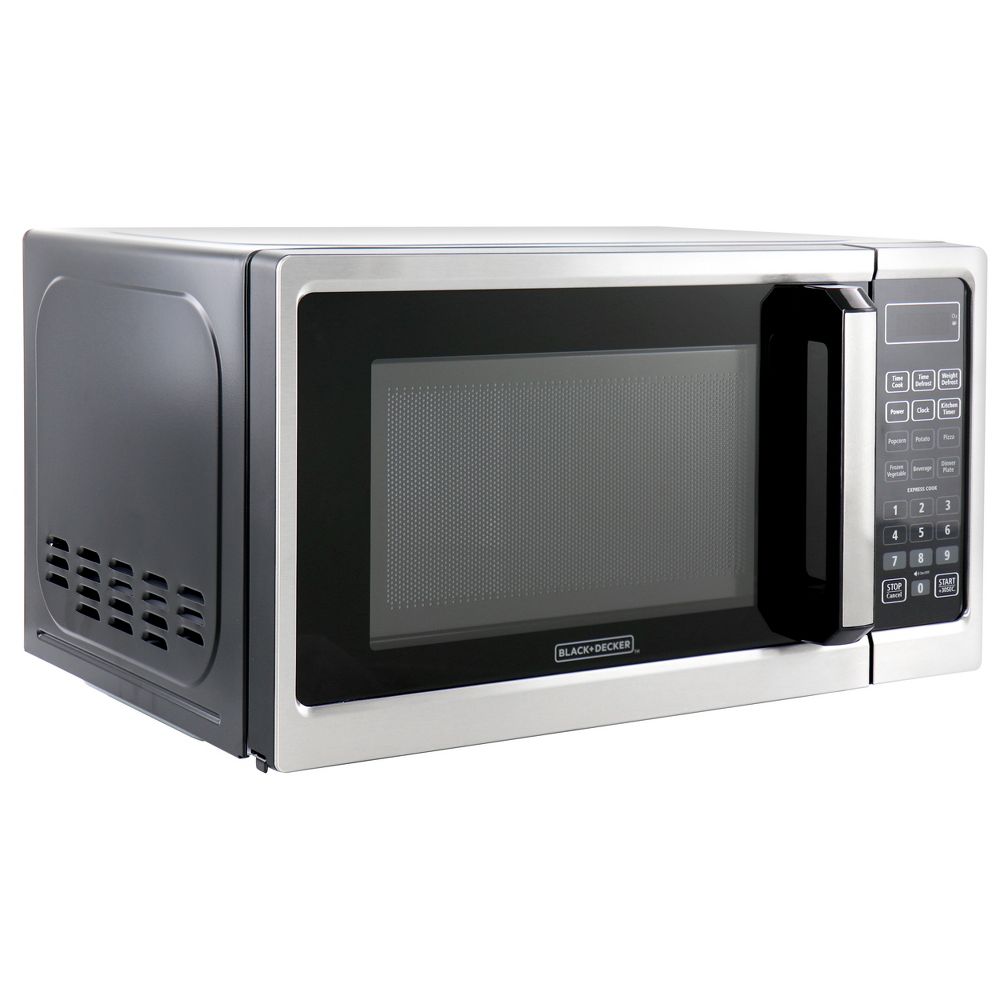
Overview: A budget-friendly compact countertop microwave with six auto menus, 10 power levels, one-touch start, and a two-step child lock. The 0.9 cu ft cavity fits a 10-inch pizza—more practical than the smallest 0.7 cu ft models without jumping to full 1.2 cu ft size.
Key strengths: Compact footprint for dorms, offices, and small kitchens; straightforward digital panel; memory function saves a preferred setting; child lock adds safety.
Drawbacks: 900W is adequate but slower than 1000W models; no mute function; some owners report louder operation and less refined fit-and-finish than premium brands.
Best use cases: Students and small households; office break rooms; anyone who wants auto menus and one-touch start without sensor-cooking complexity.
COMFEE' EM720CPL-PMB — Best for tiny spaces
Overview: The smallest microwave in this comparison at 0.7 cu ft and 700W. Built for dorms, RVs, office break rooms, and anywhere counter space is measured in inches. Mute function and ECO mode are rare at this size and price.
Key strengths: Extremely compact and lightweight; mute and ECO mode; two-step child lock; heats coffee, leftovers, and snacks quickly for light-duty use.
Drawbacks: 700W means longer cook times on larger portions; cavity is tight for big plates; some durability reports mention interior rust or failure after a couple of years.
Best use cases: Dorm rooms and RVs; office break rooms with one shared outlet; very small apartments where even 0.9 cu ft feels too big.
GE JVM3160RFSS — Best over-the-range
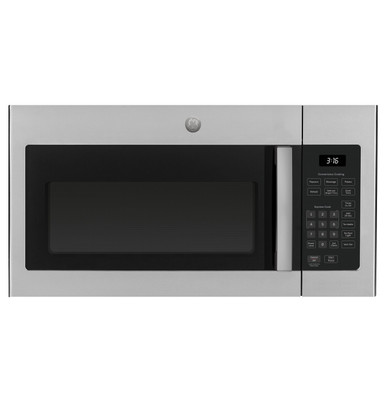
Overview: A standard 30-inch over-the-range microwave with 1.6 cu ft capacity, 1000W power, 300 CFM two-speed venting, LED cooktop lighting, and Easy Mount installation. Replaces both a countertop microwave and a range hood in one appliance.
Key strengths: Largest interior in this comparison; built-in venting and lighting save counter space; straightforward controls; turntable on/off for oversized dishes.
Drawbacks: Fan is loud on high speed; 300 CFM is adequate but not premium venting; mixed longevity reports on keypads and internal components; requires installation.
Best use cases: Homeowners replacing a standard 30-inch OTR unit; kitchens that need venting without a separate hood; families wanting maximum cavity size without sacrificing counter space.
Panasonic NE-1054F — Best programmable commercial
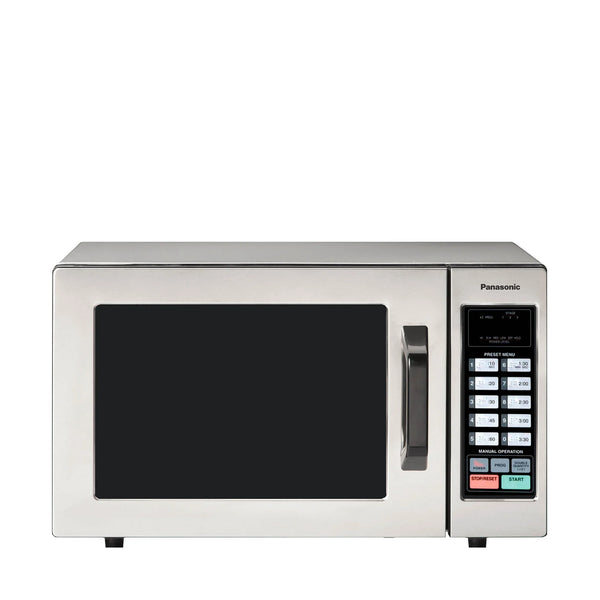
Overview: A light-duty commercial countertop microwave with bottom energy feed, no turntable, 10 programmable memory pads, and NSF/UL commercial approval. Compact at 0.8 cu ft but built for cafés, break rooms, and heavy-use home kitchens.
Key strengths: Even heating without a turntable; programmable memory for repeat items; Grab & Go handle and Braille keypad; stainless interior stands up to constant use.
Drawbacks: Loud default beeps until tone settings are adjusted; programming learning curve vs residential models; mixed reliability reports; premium price tier.
Best use cases: Café counters and food-service stations; break rooms with dozens of daily users; home cooks who reheat the same items on repeat and want commercial durability.
Sharp R-21LCFS — Best dial-only commercial
Overview: A medium-duty commercial microwave with a simple dial timer, 1.0 cu ft stainless cavity, and no turntable. The highest-rated microwave in this comparison (4.6 stars) and the pick for operators who want "twist and go" reliability.
Key strengths: Dial-only controls never confuse anyone; flat stainless floor cleans in seconds; auto-cancel timer when door opens extends magnetron life; durable build praised for years of heavy daily use.
Drawbacks: No variable power levels, sensor cooking, or multi-stage programming; industrial appearance; occasional door-handle failure reports after extended use.
Best use cases: Restaurants, food trucks, and high-traffic break rooms; home kitchens where simplicity and cleanup speed beat feature count; anyone who prefers a bomb-proof dial over a touchpad.
How to choose the right microwave
Start with three questions: how much counter (or cabinet) space do you have, how often do you microwave food, and do you need venting above your stove?
By kitchen size and installation
- Tiny counter or RV/dorm: COMFEE' EM720CPL-PMB (0.7 cu ft)
- Small but practical counter: BLACK+DECKER 0.9 cu ft
- Standard family counter: TOSHIBA EM131A5C-SS (1.2 cu ft)
- 30-inch opening above the stove: GE JVM3160RFSS over-the-range
- Commercial counter or heavy daily use: Panasonic NE-1054F (programmable) or Sharp R-21LCFS (dial-only)
By how you cook
- Light-duty reheating (coffee, snacks, single leftovers): COMFEE' or BLACK+DECKER
- Daily family reheating with fewer guesswork cycles: TOSHIBA with sensor cooking
- Built-in kitchen integration with venting: GE over-the-range
- All-day commercial reheating with fast cleanup: Sharp R-21LCFS or Panasonic NE-1054F
By features that matter to you
- Noise sensitivity / babies / open-plan kitchen: TOSHIBA or COMFEE' (both have mute)
- Child safety: TOSHIBA (handle design), COMFEE' and BLACK+DECKER (two-step lock)
- Standby energy savings: TOSHIBA or COMFEE' (ECO mode)
- Sensor cooking: TOSHIBA only among residential models
- No turntable / easy cleaning: Panasonic or Sharp commercial models
- Simplest possible operation: Sharp R-21LCFS dial timer
Our concrete recommendations
Choose the COMFEE' if you are in a dorm or RV and just need light-duty reheating in a tiny space. At 0.7 cu ft and 700W it is not fast on big portions, but it is the only model here that genuinely fits where others will not.
Choose the TOSHIBA if you want a versatile family microwave with sensor cooking, mute mode, and a reasonable footprint. It is the best balance of capacity, power, and smart features in a residential countertop package.
Choose the GE over-the-range if you are a homeowner with a standard 30-inch opening and want to reclaim counter space while getting built-in venting and the largest cavity in this comparison.
Choose the Sharp R-21LCFS if you prefer a bomb-proof, dial-only commercial microwave that is easy to clean and use all day. Twist the timer, heat the food, wipe the flat floor—done.
Choose the Panasonic NE-1054F if you need programmable memory pads for repeat menu items in a food-service or high-volume break-room setting where staff reheats the same dishes dozens of times daily.
Choose the BLACK+DECKER if you want a compact microwave that fits a 10-inch pizza and has straightforward auto menus—without paying for sensor features or commercial-grade construction you will not use.
Frequently asked questions
What is the best microwave for a small kitchen or dorm?
The COMFEE' EM720CPL-PMB is the smallest at 0.7 cu ft and 700W—built for dorms, RVs, and tight counters. If you need a 10-inch pizza to fit, step up to the BLACK+DECKER 0.9 cu ft model for 900W and a slightly larger cavity without jumping to full 1.2 cu ft size.
Which microwave is best for families?
The TOSHIBA EM131A5C-SS is the best family countertop pick with 1.2 cu ft, 1000W, and a smart humidity sensor. If you have a 30-inch over-the-range opening, the GE JVM3160RFSS offers even more space at 1.6 cu ft plus built-in venting.
Do I need a turntable?
Residential models all include turntables, which help even heating for most plate-shaped food. Commercial models (Panasonic and Sharp) skip the turntable in favor of a flat stainless floor with bottom energy feed—better for rectangular containers, multiple items, and fast cleanup, but a different heating approach that takes a meal or two to get used to.
Is a commercial microwave worth it for home use?
Only if you microwave heavily—multiple times daily, large portions, or repeat items on a schedule. Commercial models trade consumer features (sensor, mute, auto menus) for durability, flat-floor cleaning, and all-day reliability. For occasional reheating, a residential TOSHIBA or BLACK+DECKER is simpler and far less expensive.
Over-the-range or countertop?
Over-the-range if you own your home, have a 30-inch cabinet opening, and want venting plus counter space back. Countertop if you rent, lack ductwork, or want plug-and-play flexibility. The GE JVM3160RFSS is the only over-the-range model in this comparison.
Which microwave is the quietest?
The TOSHIBA EM131A5C-SS is widely praised for quiet operation and has a dedicated mute function. The COMFEE' also offers sound on/off. The BLACK+DECKER and GE are generally louder, and commercial models (Panasonic especially) have loud default beeps—though the Panasonic's tone can be adjusted in settings.